Thursday, 18 October 2012
Monday, 15 October 2012
What a fantastic weekend in Maryvale!

I have just had a weekend at the Maryvale Institute, and what a wonderful and hopeful experience it was.
The Maryvale Institute is an international catholic distance-learning college for catechesis, theology, philosophy and religious eduction. Maryvale House was for a time the home of Blessed John Henry Newman, and also a shrine of the Sacred Heart.
I stayed at Maryvale for what seems on the face of it the most dreary of reasons: a research methodology course. This is a requirement for the MA in Pastoral Theology that I am studying.
So what was so incredible about the weekend? It was the people and the place.
The Institute is international, and around fifty of us gathered, not just from England, but other parts of the world. There were about a dozen priests, religious sisters, a monk, and lots of enthusiastic lay people. It was a joy to meet them! How wonderful and stimulating it is to be with people who are so fired up by their faith. Fired up, but also willing to study with rigour. It was also very apparent that it was not a place just for the 'intellectual type', if you know what I mean. It was not a group of people who just liked intellectual challenges and could have done an MA in anything, but ordinary people who wanted to make the effort of deepening their understanding of the faith. And Maryvale helps us to do that. It was a glimpse of the wider church, of diverse people with many different gifts and character, all pulling together and supporting one another, and all searching for what God wanted them to be doing in His Church.
Maryvale House is also a very special place to be. I suspect there are two reasons for this. First that Blessed John Henry Newman lived and prayed there for a number of years. The altar in the chapel was where Newman celebrated his first mass in England after ordination in Rome. The aims and objectives of the Institute fit in very well with Newman's vision that I am confident that this is because of his prayer. The second reason it is a special place is because the Bridgettine nuns who live there and provide hospitality are also contemplatives. Their prayer, at the heart of the house, means it is a real living house of prayer. They sing their offices beautifully and showed wonderful care for us all. There is beauty and joy at the heart of the house.
And now we have heard (Dr Carolyn Farey received message from pope) that one of the member's of staff, Dr Carolyn Farey, received a message from the Holy Father himself on behalf of all those who transmit the faith! A tremendous honour for her, but also one for the Institute and its work. Her colleague, Dr Petroc Willey, is also in Rome as one of the other 'experts' working with the bishops on this Synod about New Evangelisation.
 As you can tell I would recommend the Maryvale Institute for anyone who wants to deepen their faith. There are all sorts of distance learning courses ; why not look at the website and see if there is one for you? Maryvale website
There will also be an opportunity early in November for people to meet with Carolyn as she will be visiting Torbay. More details soon.


Friday, 12 October 2012
Pope Benedict XVI 'Being tepid is the greatest danger to Christians'
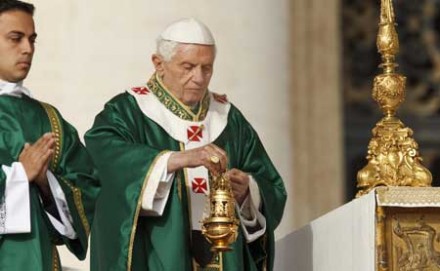
“Our role in the new evangelisation is to cooperate with God,” the Pope told more than 260 cardinals, bishops and priests who are members of the world Synod of Bishops on the new evangelisation. “We can only let people know what God has done.”
In a 21-minute, off-the-cuff reflection during morning prayer at the synod’s opening session today, Pope Benedict spoke of the importance of prayer in the Church’s push for a new evangelisation, the meaning of evangelisation, and sharing the Gospel through both proclamation and charity.
The Pope examined the use of the word “evangelion”, the Greek term that is the root of the English word “evangelisation”, and which is itself translated as “Gospel”. In the Book of Isaiah, he noted, the Hebrew equivalent of the word describes “the voice that announces a victory, that announces goodness, joy and happiness”, transmitting the message that “God has not forgotten his people”, and that he intervenes with power in history to save them. In the New Testament, the Pope said, “evangelion” is the good news of the incarnation of Christ, the coming of God’s son into the world to save humanity.
For the people of Israel suffering under Roman rule, it was truly good news that God spoke to his people and came to live among them, the Pope said. News of Jesus’s birth was the answer to those who questioned whether there really was a God; whether he knew his people and the circumstances of their lives; and whether he had any power to change their situation.
People today have the same questions, the Pope said: “Is God a reality or not? Why is he silent?” When Christians evangelise, they must remember that their “faith has content”, and that what they believe and seek to share with others is outlined in the Creed, he said. They must use their intelligence to reflect on the tenets of their faith and use their mouths to proclaim it. Because faith isn’t an abstract notion, Christians also must live their faith and share it with the world through acts of charity and love, the Pope said.
“Being tepid is the greatest danger for Christians,” he said. “We pray that faith becomes like a fire in us and that it will set alight others.”
The synod formally opened on 7th with a Mass in St Peter’s Square. During his homily, Pope Benedict said that the “Church exists to evangelise” by sharing the Gospel with people who have never heard of Christ, strengthening the faith of those who already have been baptised and reaching out to those who “have drifted away from the Church”.
“At various times in history,” he said, “divine providence has given birth to a renewed dynamism in the church’s evangelising activity”, as happened, for example, with the evangelisation of the Americas beginning late in the 15th century. “Even in our own times, the Holy Spirit has nurtured in the Church a new effort to announce the good news,” the Pope said.
The modern effort to proclaim salvation in Christ to the modern world found “a more universal expression and its most authoritative impulse in the Second Vatican Ecumenical Council”, which opened 50 years ago on Thursday, October 11.
The Pope said the synod was dedicated to helping people strengthen their faith and to helping those who have drifted away “encounter the Lord, who alone who fills existence with deep meaning and peace; and to favour the rediscovery of the faith, that source of grace which brings joy and hope to personal, family and social life”.
Thursday, 11 October 2012
Maryvale experts responsible for Catechesis on family and on the Catechism

First thing on Tuesday morning members of Maryvale’s Catechetical team attended Mass in the grottos of St Peter’s amidst the tombs of the Popes on the feast of Blessed John Henry Newman. This was taken as a great blessing on the work of Maryvale at the Synod and into the future.
The big news we have from the Synod is that the experts were allocated their areas of responsibility, in particular which paragraphs of the Synod’s documents they are responsible for.
Dr Caroline Farey is responsible for para 111, Catechesis on the Family, the transmission of the faith in the family. Dr Petroc Willey is responsible the paragraph dealing with the Catechism of the Catholic Church and its use.
In practice, this means that Petroc and Caroline have to listen to the 45 or so interventions made by the Bishops each day and note any reference, comment, suggest, that relates to their paragraphs. At the end of each day Caroline and Petroc have to write a one page summary of the most important points made about the Catechesis on the Family and the Catechism of the Church.
(Last week Dr Caroline Farey gave a day of lectures at Buckfast Abbey to the Ordinariate Clergy.)
Pope: Homily for Synod opening

On Sunday Pope Benedict XVI proclaimed the XIII Ordinary General Assembly of the Synod of Bishops on the New Evangelisation open during the celebration of Mass in St. Peter’s Square before a congregation of thousands. During Mass, he also proclaimed two new Doctors of the Church.
Below the full text of Pope Benedict XVI’s Homily, Sunday October 7th, 2012:
With this solemn concelebration we open the thirteenth Ordinary General Assembly of the Synod of Bishops on the theme The New Evangelization for the Transmission of the Christian Faith. This theme reflects a programmatic direction for the life of the Church, its members, families, its communities and institutions. And this outline is reinforced by the fact that it coincides with the beginning of the Year of Faith, starting on 11 October, on the fiftieth anniversary of the opening of the Second Vatican Ecumenical Council. I give a cordial and grateful welcome to you who have come to be part of the Synodal Assembly, in particular to the Secretary-General of the Synod of Bishops, and to his colleagues. I salute the fraternal delegates of the other churches and ecclesial communities as well as all present, inviting them to accompany in daily prayer the deliberations which will take place over the next three weeks.
The readings for this Sunday’s Liturgy of the Word propose to us two principal points of reflection: the first on matrimony, which I will touch shortly; and the second on Jesus Christ, which I will discuss now. We do not have time to comment upon the passage from the Letter to the Hebrews but, at the beginning of this Synodal Assembly, we ought to welcome the invitation to fix our gaze upon the Lord Jesus, “crowned with glory and honour, because of the suffering of death (2:9). The word of God places us before the glorious One who was crucified, so that our whole lives, and in particular the commitment of this Synodal session, will take place in the sight of him and in the light of his mystery. In every time and place, evangelization always has as its starting and finishing points Jesus Christ, the Son of God (cf. Mk 1:1); and the Crucifix is the supremely distinctive sign of him who announces the Gospel: a sign of love and peace, a call to conversion and reconciliation. My dear Brother Bishops, starting with ourselves, let us fix our gaze upon him and let us be purified by his grace. I would now like briefly to examine the new evangelization, and its relation to ordinary evangelization and the mission ad Gentes. The Church exists to evangelize. Faithful to the Lord Jesus Christ’s command, his disciples went out to the whole world to announce the Good News, spreading Christian communities everywhere. With time, these became well-organized churches with many faithful. At various times in history, divine providence has given birth to a renewed dynamism in Church’s evangelizing activity. We need only think of the evangelization of the Anglo-Saxon peoples or the Slavs, or the transmission of the faith on the continent of America, or the missionary undertakings among the peoples of Africa, Asia and Oceania. It is against this dynamic background that I like to look at the two radiant figures that I have just proclaimed Doctors of the Church, Saint John of Avila and Saint Hildegard of Bingen. Even in our own times, the Holy Spirit has nurtured in the Church a new effort to announce the Good News, a pastoral and spiritual dynamism which found a more universal expression and its most authoritative impulse in the Second Vatican Ecumenical Council. Such renewed evangelical dynamism produces a beneficent influence on the two specific “branches” developed by it, that is, on the one hand the Missio ad Gentes or announcement of the Gospel to those who do not yet know Jesus Christ and his message of salvation, and on the other the New Evangelization, directed principally at those who, though baptized, have drifted away from the Church and live without reference to the Christian life. The Synodal Assembly which opens today is dedicated to this new evangelization, to help these people encounter the Lord, who alone who fills existence with deep meaning and peace; and to favour the rediscovery of the faith, that source of grace which brings joy and hope to personal, family and social life. Obviously, such a special focus must not diminish either missionary efforts in the strict sense or the ordinary activity of evangelization in our Christian communities, as these are three aspects of the one reality of evangelization which complement and enrich each other.
 The theme of marriage, found in the Gospel and the first
reading, deserves special attention. The message of the word of God may
be summed up in the expression found in the Book of Genesis and taken up
by Jesus himself: “Therefore a man leaves his father and his mother and
cleaves to his wife, and they become one flesh” (Gen 2:24; Mk 10:7-8).
What does this word say to us today? It seems to me that it invites us
to be more aware of a reality, already well known but not fully
appreciated: that matrimony is a Gospel in itself, a Good News for the
world of today, especially the dechristianized world. The union of a man
and a woman, their becoming “one flesh” in charity, in fruitful and
indissoluble love, is a sign that speaks of God with a force and an
eloquence which in our days has become greater because unfortunately,
for various reasons, marriage, in precisely the oldest regions
evangelized, is going through a profound crisis. And it is not by
chance. Marriage is linked to faith, but not in a general way. Marriage,
as a union of faithful and indissoluble love, is based upon the grace
that comes from the triune God, who in Christ loved us with a faithful
love, even to the Cross. Today we ought to grasp the full truth of this
statement, in contrast to the painful reality of many marriages which,
unhappily, end badly. There is a clear link between the crisis in faith
and the crisis in marriage. And, as the Church has said and witnessed
for a long time now, marriage is called to be not only an object but a
subject of the new evangelization. This is already being seen in the
many experiences of communities and movements, but its realization is
also growing in dioceses and parishes, as shown in the recent World
Meeting of Families.One of the important ideas of the renewed impulse
that the Second Vatican Council gave to evangelization is that of the
universal call to holiness, which in itself concerns all Christians (cf.
Lumen Gentium, 39-42). The saints are the true actors in evangelization
in all its expressions. In a special way they are even pioneers and
bringers of the new evangelization: with their intercession and the
example of lives attentive to the inspiration of the Holy Spirit, they
show the beauty of the Gospel to those who are indifferent or even
hostile, and they invite, as it were tepid believers, to live with the
joy of faith, hope and charity, to rediscover the taste for the word of
God and for the sacraments, especially for the bread of life, the
Eucharist. Holy men and women bloom among the generous missionaries who
announce the Good News to non-Christians, in the past in mission
countries and now in any place where there are non-Christians. Holiness
is not confined by cultural, social, political or religious barriers.
Its language, that of love and truth, is understandable to all people of
good will and it draws them to Jesus Christ, the inexhaustible source
of new life.
At this point, let us pause for a moment to appreciate the two saints who today have been added to the elect number of Doctors of the Church. Saint John of Avila lived in the sixteenth century. A profound expert on the sacred Scriptures, he was gifted with an ardent missionary spirit. He knew how to penetrate in a uniquely profound way the mysteries of the redemption worked by Christ for humanity. A man of God, he united constant prayer to apostolic action. He dedicated himself to preaching and to the more frequent practice of the sacraments, concentrating his commitment on improving the formation of candidates for the priesthood, of religious and of lay people, with a view to a fruitful reform of the Church.Saint Hildegard of Bingen, an important female figure of the twelfth century, offered her precious contribution to the growth of the Church of her time, employing the gifts received from God and showing herself to be a woman of brilliant intelligence, deep sensitivity and recognized spiritual authority. The Lord granted her a prophetic spirit and fervent capacity to discern the signs of the times. Hildegard nurtured an evident love of creation, and was learned in medicine, poetry and music. Above all, she maintained a great and faithful love for Christ and the Church.
This summary of the ideal in Christian life, expressed in the call to holiness, draws us to look with humility at the fragility, even sin, of many Christians, as individuals and communities, which is a great obstacle to evangelization and to recognizing the force of God that, in faith, meets human weakness. Thus, we cannot speak about the new evangelization without a sincere desire for conversion. The best path to the new evangelization is to let ourselves be reconciled with God and with each other (cf. 2 Cor 5:20). Solemnly purified, Christians can regain a legitimate pride in their dignity as children of God, created in his image and redeemed by the precious blood of Jesus Christ, and they can experience his joy in order to share it with everyone, both near and far.Dear brothers and sisters, let us entrust the work of the Synod meeting to God, sustained by the communion of saints, invoking in particular the intercession of great evangelizers, among whom, with much affection, we ought to number Blessed John Paul II, whose long pontificate was an example of the new evangelization. Let us place ourselves under the protection of the Blessed Virgin Mary, Star of the New Evangelization. With her let us invoke a new outpouring of the Holy Spirit, that from on high he may illumine the Synodal assembly and make it fruitful for the Church’s way ahead.
Evangelisation must flow from experience, says Anglican leader

Evangelisation is not a project, but the natural "overflow" of an experience of Christ and his church that transforms lives, giving them meaning and joy, the spiritual leader of the Anglican Communion told Pope Benedict XVI and the Synod of Bishops, reports the Catholic News Service.
"Those who know little and care even less about the institutions and hierarchies of the church these days" nevertheless are attracted and challenged by Christians whose lives show they have been transformed by their encounter with Christ, said Archbishop Rowan Williams of Canterbury, head of the Church of England.
The leader of the Anglican Communion was invited by Pope Benedict to deliver a major address at the synod on the new evangelisation October 10.
Archbishop Williams began his talk by remembering the Second Vatican Council, which, he said, was a sign that "the church was strong enough to ask itself some demanding questions about whether its culture and structures were adequate to the task of sharing the Gospel with the complex, often rebellious, always restless mind of the modern world."
Presenting the Gospel means being confident that it has a distinctive, life-giving message, the archbishop said. Confidence in the message, and not in oneself, can be cultivated only through contemplation, he said.
"With our minds made still and ready to receive, with our self-generated fantasies about God and ourselves reduced to silence, we are at last at the point where we may begin to grow," he said.
"The face we need to show to our world is the face of a humanity in endless growth toward love, a humanity so delighted and engaged by the glory of what we look toward that we are prepared to embark on a journey without end to find our way more deeply into it," Archbishop Williams told the synod.
During an interview earlier in the day with Catholic News Service and Vatican Radio, the archbishop said, "If evangelisation is just rallying the troops or just trying to get people to sign up, something's missing -- what's missing is the transformed humanity that the Gospel brings us."
The archbishop urged the synod to support the Taize ecumenical community and similar ecumenical efforts that help people learn prayer and contemplation. "The more we keep apart from each other as Christians of different confessions," the less convincing we will be, he told synod members.
He also told the pope and synod participants that nurturing a habit of contemplation "strips away an unthinking superiority toward other baptized believers and the assumption that I have nothing to learn from them."
FULL STORY Evangelisation must flow from experience, Anglican leader tells synod (CNS)
Patriarch Bartholomew at opening Mass of the Year of Faith

This is the full text of Ecumenical Patriarch Bartholomew’s address at the opening Mass of the Year of Faith in Rome this morning:
Beloved brother in the Lord, Your Holiness Pope Benedict;
Brothers and Sisters;
As Christ prepared for His Gethsemane experience, He prayed a prayer for unity which is recorded in the Gospel of Saint John Chapter 17 verse 11: “. . . keep through Your name those whom You have given Me, that they may be one as We are”. Through the centuries we have, indeed, been kept in the power and love of Christ, and in the proper moment in history the Holy Spirit moved upon us and we began the long journey towards the visible unity that Christ desires. This has been confirmed in Unitatis Redintegratio §1:
Everywhere large numbers have felt the impulse of this grace, and among our separated brethren also there increases from day to day the movement, fostered by the grace of the Holy Spirit, for the restoration of unity among all Christians.
Fifty years ago in this very square, a powerful and pivotal celebration captured the heart and mind of the Roman Catholic Church, transporting it across the centuries into the contemporary world. This transforming milestone, the opening of the Second Vatican Council, was inspired by the fundamental reality that the Son and incarnate Logos of God is “…where two or three are gathered in his name” (Matt.18.20) and that the Spirit, who proceeds from the Father, “…will guide us into the whole truth.” (John 16.13).
In the 50 years that have intervened, we recall with vividness and tenderness, but also with elation and enthusiasm, our personal discussions with episcopal members and theological periti during our formative time – then as a young student – at the Pontifical Oriental Institute, as well as our personal attendance at some special sessions of the Council. We witnessed firsthand how the bishops experienced a renewed awareness of the validity – and a reinforced sense of the continuity – of the tradition and faith “once for all delivered to the saints” (Jude 1.3). It was a period of promise and hope for your Church both internally and externally.
For the Orthodox Church, we have observed a time of exchange and expectation. For example, the convocation of the first Pan-Orthodox Conferences in Rhodes led to the Pre-Conciliar Pan-Orthodox Conferences in preparation for the Great Council of the Orthodox Churches. These exchanges will demonstrate the unified witness of the Orthodox Church in the modern world. Moreover, it coincided with the “dialogue of love” and heralded the Joint International Commission for Theological Dialogue between the Roman Catholic and the Orthodox Church, which was established by our venerable predecessors Pope John Paul II and Ecumenical Patriarch Dimitrios.
Over the last five decades, the achievements of this assembly have been diverse as evidenced through the series of important and influential constitutions, declarations, and decrees. We have contemplated the renewal of the spirit and “return to the sources” through liturgical study, biblical research, and patristic scholarship. We have appreciated the struggle toward gradual liberation from the limitation of rigid scholasticism to the openness of ecumenical encounter, which has led to the mutual rescinding of the excommunications of the year 1054, the exchange of greetings, returning of relics, entering into important dialogues, and visiting each other in our respective Sees.
Our journey has not always been easy or without pain and challenge, for as we know “narrow is the gate and difficult is the way” (Matthew 7.14). The essential theology and principal themes of the Second Vatican Council – the mystery of the Church, the sacredness of the liturgy, and the authority of the bishop – are difficult to apply in earnest practice, and constitute a life-long and church-wide labor to assimilate. The door, then, must remain open for deeper reception, pastoral engagement, and ecclesial interpretation of the Second Vatican Council.
As we move forward together, we offer thanks and glory to the living God – Father, Son and Holy Spirit – that the same assembly of bishops has recognised the importance of reflection and sincere dialogue between our “sister churches”. We join in the “. . . hope that the barrier dividing the Eastern Church and the Western Church will be removed, and that – at last – there may be but the one dwelling, firmly established on Christ Jesus, the cornerstone, who will make both one” (Unitatis Redintegratio §18).
With Christ as our cornerstone and the tradition we share, we shall be able – or, rather, we shall be enabled by the gift and grace of God – to reach a better appreciation and fuller expression of the Body of Christ. With our continued efforts in accordance with the spirit of the tradition of the early Church, and in the light of the Church of the Councils of the first millennium, we will experience the visible unity that lies just beyond us today.
The Church always excels in its uniquely prophetic and pastoral dimension, embraces its characteristic meekness and spirituality, and serves with humble sensitivity the “least of these My brethren” (Matt. 25.40).
Beloved brother, our presence here signifies and seals our commitment to witness together to the Gospel message of salvation and healing for the least of our brethren: the poor, the oppressed, the forgotten in God’s world. Let us begin with prayers for peace and healing for our Christian brothers and sisters living in the Middle East. In the current turmoil of violence, separation, and brokenness that is escalating between peoples and nations, may the love and desire for harmony we profess here, and the understanding we seek through dialogue and mutual respect, serve as a model for our world. Indeed, may all humanity reach out to ‘the other’ and work together to overcome the suffering of people everywhere, particularly in the face of famine, natural disasters, disease, and war that ultimately touches all of our lives.
In light of all that has yet to be accomplished by the Church on earth, and with great appreciation for all the progress we have shared, we are, therefore, honored to be invited to attend – and humbled to be called to address – this solemn and festive commemoration of the Second Vatican Council. It is fitting that this occasion also marks for your Church the formal inauguration of the “Year of Faith”, as it is faith that provides a visible sign of the journey we have traveled together along the path of reconciliation and visible unity.
In closing, Your Holiness, Beloved Brother, we wholeheartedly congratulate you – together with the blessed multitude assembled here today – and we fraternally embrace you on the joyous occasion of this anniversary celebration. May God bless you all.
Subscribe to:
Posts (Atom)
-
A group of Anglican nuns from the Community of St Mary the Virgin (CSMV) in Wantage, Oxfordshire, are to be received into the full co...
-
 1 . St Mary Magdalene On Friday 22nd July the parish of Our Lady & St. Mary Magdalene, Tavistock, celebrated it's Patronal Festi...
-
 On the solemn feast of Our Lord Jesus Chist, universal King, the Buckfast Ordinariate Group celebrated Sunday mass in a different location...
