From the Christian Institute:The right of churches to decide for themselves who may attend Holy Communion is being challenged by the Charity Commission. The Commission has refused to register a Plymouth Brethren group because its Holy Communion services are for members only. This would have a huge impact on the group’s tax relief and would also have other implications.
Elders from the Plymouth Brethren gave evidence on the matter to a parliamentary select committee last week.During the evidence a letter from the Commission’s head of legal
services emerged claiming that churches cannot be assumed to be acting
for the public good. It said: “This decision makes it clear that there was no presumption
that religion generally, or at any more specific level, is for the
public benefit, even in the case of Christianity or the Church of
England.”...
Colleen Francis made himself right at home in the locker room at
Evergreen College in Olympia, Washington. The forty-five year-old
student showered, used the sauna and walked around naked in front of the
other people using those facilities.
Now if you’re having trouble squaring the name “Colleen” with the
male pronoun “himself,” you’re not the only one. Those present in the
locker room also had trouble with the combination that the locker room
in question was the women’s room and “Colleen” is anatomically a male.
Thus when he showers, sits in the sauna, and walks around naked,
Francis is exposing himself not only to his fellow students but students
from local high schools and families who also use the college’s
swimming pool and locker room. Thus, among the females he has exposed
himself to are minors, some as young as six.
If you’re wondering, “Why doesn’t someone stop Francis,” well, they
tried to, and that’s when the story became surreal. The swimming coach
from the local high school and the mother of one of the team members
called the police. When the police arrived Francis informed them that he
was a transsexual and that, under Washington State law, he was entitled
to use the women’s locker room.
If that sounds ridiculous to you, well, it worked. The coach
apologized and the college informed parents that state law, which
prohibits discrimination on the basis of “gender expression or
identity,” tied their hands. The best they could do was to provide
screens for those made “uncomfortable” by Francis’ presence.
As we imagine the scene
at the treasury of the Temple, we ought to try to imagine perhaps
someone giving to the Church, perhaps our congregation today. How
would we respond if someone walked in and dropped in a fat cheque?
How would our response differ to, say, a child putting in their
week's pocket money? Would we treat them differently? I suggest most
of us would.
The truth our Lord
reveals is that God sees things very differently. Our Lord would
assess any gift on the basis of the degree of sacrifice involved, and
the degree of generosity. St John Chrysostom, commenting on this
said, “Our Lord paid no attention to the amount of money but only
to the abundance of her generosity.” What the Lord looks for is our
generosity. So it might be a worthwhile exercise imagining our Lord
watching us as we give – what would he say of us? Well the truth
is, that our Lord knows the secrets of our hearts now, and He is
aware of the truth of the matter. There is perhaps nothing like the
issue of money to crystallize our commitment to something.
Central in this concern
for generosity is what we might call today 'detachment'. How detached
are we from our wealth? To what extent are we ruled by our wealth?
How free do we feel towards our wealth – beyond providing for our
basic needs? How much of a hold does our wealth have over us?
The Beatitudes of the
gospel call us to blessedness through being 'poor in spirit'. This
isn't to do with whether we are economically poor or not, but how
detached we are to our wealth. Blessedness, or eternal happiness or
joy, is reached through a detachment to wealth.
People become attached
to wealth because they believe it can provide them with the security
they need. This is in fact the opposite to the Christian way. For a
Christian finds security not in material possessions but in Christ.
The Christian does not build up treasures on earth, where moth and
rust can corrupt, but builds up treasure in heaven. It might seem we
can buy security and happiness, but sooner or later we must all learn
that we cannot take it with us! Christ alone can give us eternal
happiness (which is what blessedness is) and eternal security (which
is salvation) ; we in fact depend on His great generosity bestowed on
us – He asks us to be as generous with others.
So the issue we are
addressing is not just to do with how much we give to Church, but the
attitude of our hearts. Do we have hearts formed by habits of
miserliness, that is grudging, or that is over cautious? Because this
will not only affect the way we give money, but also the way in which
we give ourselves to Christ. How wholeheartedly have we given
ourselves to Christ? How much have we held back? How generous are we
in giving our lives, our time, our energy to Christ? If He stood
before us in bodily flesh would you give all, or be reserved? Are there
no-go areas in our lives, where we are not prepared for Christ to
enter?
These are the things
that matter in the Kingdom of God. What matters to God is not the
quantity but the quality of the spirit in which we give. Do we give
as generously, as He has given to us?
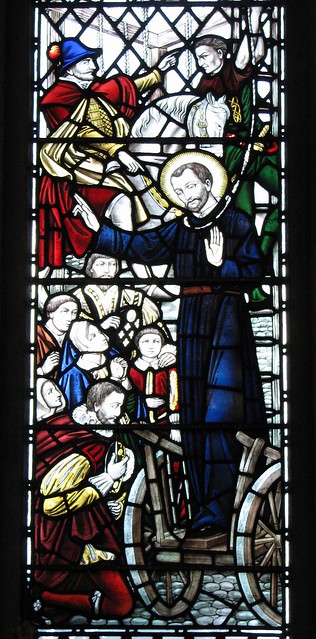
English martyr, born 1550 at Rodesley, near Longford, Derbyshire; died at Tyburn, 1 December, 1581. In 1568 Sir William Petre nominated him to one of the eight fellowships which he had founded at Exeter College, Oxford, probably acting under the influence of the martyr's uncle, John Woodward, who from 1556 to 1566 had been rector of Ingatestone, Essex, where Sir William lived. There Blessed Ralph took the degree of M.A., 2 July, 1574, and was accounted "an acute philosopher, and an excellent Grecian and Hebrician". In 1575 he fled abroad and went to the English College at Douai, where 23 March, 1577, he was ordainedpriest by the Bishop of Cambrai. On 2 August, 1577, he left for Rome, where he stayed at the English College nearly three years, becoming leader of the movement, which placed it under the supervision of the Jesuits. On 18 April, 1580, he set out for England, a member of a party of fourteen; at Milan they were guests of St. Charles for eight days, and Blessed Ralph preached before him. On 9 November, 1580, he was imprisoned in the Marshalsea, where he converted many fellow prisoners,
and on 4 December was transferred to the Tower, where he was severely
racked, 15 December, and afterwards laid out in the snow. The next day
he was racked again, after which second torture he "lay for five days
and nights without any food or speaking to anybody. All which time he lay, as he thought in a sleep, before our Saviour on the Cross. After which time he came to himself, not finding any distemper in his joints by the extremity of the torture." After a year's imprisonment he was brought to trial, on an absurd charge of treasonable
conspiracy, in Westminster Hall 20 November, 1581, and being found
guilty was taken back to the Tower, whence he was drawn to Tyburn on a
hurdle shared by Blessed Alexander Briant. He suffered very bravely, his last words being, Jesu, Jesu, Jesu, esto mihi Jesus!
Throughout the history of the Old Testament, Israel was able to discover that God only had one reason to reveal Himself to them. They discovered only one motive for God to choose them from among the peoples as His special people. And that reason, and that motive, was sheer, gratuitous love.
It was out of love that God never stopped saving them and pardoning their unfaithfulness and sins. Ultimately it is the reason for His greatest gift: “God so loved the world that he gave his only Son.”
This is of course our perspective with hindsight, it wasn't necessarily the perspective of all Jews at the time of our Lord. When therefore a scribe asks a question of Jesus and asks what is the first commandment, and Jesus gives the commandment to love, it wasn't necessarily an answer that everyone would have agreed with. So Jesus commends the Scribe for recognising this fundamental reality. While every Jew no doubt recognised the necessity of loving God with all one's heart and soul and strength; not everyone would have understood that this also implies love of all human beings. And even the suggestion that we should love our neighbour, could have meant to only love fellow Jews. For Christ however it is clear that the love of neighbour means, the love of everyone, even our enemies.
St John, in his epistle, goes even further, when he says that God is love. God's very being is love. In time the Church would say that God is an eternal exchange of love between Father, Son and Holy Spirit, calling this Trinity. God's very being is not solitary, is not aloneness – God's being is trinitarian, a perfect interchange of three Persons in perfect relation, in perfect love.
Some might say that this is all very fine, what a nice image of God, but does it make any difference? It could all remain theoretical, unless we also acknowledge that human beings are made in the image and likeness of God. This is a fundamental principle for Jews and Christians. What we believe about God has a direct effect on the way we understand human beings and how we behave towards one another. Being made in the image and likeness of God, and God being an eternal interchange of love, means that for human beings our destiny is an eternal interchange of love. We are made out of love, we are made for love, to be loved, to give love, to find meaning in love and to worship our God who is perfect love, and walk the path that leads to eternal love.
So the commandments are summed up in two of the commandments from the Law of Moses, but both are bound up together: the love of God and the love of neighbour. Unless we love God with all our heart, soul and strength, that is with our whole being, we will not know who God is. For God can only be approached by love. We do not grow closer to God by walking. We grow closer to God, and know God, through love. And we cannot truly say we love God, if we do not love our neighbour, love all those who are made in the image of God. The two are bound up together.
Love, then is the very heart or core of our Faith. St Paul tells us that of the gifts of the Holy Spirit, the greatest is love. The three virtues Faith, Hope and Love are the three crucial things we must grow in to make us fit for Heaven, but the greatest, as St Paul says, is Love.
Finally we have to of course remember that love is not just sentiment – Jesus said, “Greater love hath no man than this, that he give up his life for his friends.” We are called to give up our lives for love, out of love, in love for this is the nature of the Trinity – each Person gives all for the sake of the other. God empties Himself to be born in human flesh. And we are called to do the same. Our Lady, the first disciple, emptied herself in order to respond in love – Be it unto me according to thy will. And likewise are we called to empty ourselves for love. Amen.