Friday, 10 April 2015

It is the Lord!


The risen Lord appears to the disciples again continuing to build up their faith. But yet again they do not immediately recognise Him. On this occasion they are fishing in Galilee (or Sea of Tiberias) when someone calls to them and invites them to cast their net on the right side of the boat. They do not recognise that the person is Christ. Nevertheless they do as they are told and they bring in a miraculous catch. The fish are in such great numbers that they cannot draw in the net, though the net does not break. Meanwhile Peter suddenly recognises that the person is the Lord.

This resurrection appearance has been long understood to have an allegorical meaning, as well as its literal meaning. In this episode we see symbolically the nature of the Church affirmed. The boat represents the Church, the sea the world, the fish those who enter the Church, and the net represents the unity of the Church that does not break but can contain unlimited numbers of members. If St Jerome is right and people thought then that there were 153 different species of fish, then symbolically the net of 153 fish symbolises the universality or catholicity of the Church, the Church for all nations and peoples. Peter in this episode represents the papacy and the magisterium (teaching authority) who leads the Church in confirming its members in the Faith.

The risen Lord’s invitation to breakfast is also a reminder of the Eucharist. In St John’s gospel the other reminder of the Eucharist is the feeding of the multitude, again at the side of Lake Galilee. Christ, the risen Lord, continues to invite us to His heavenly banquet. During Mass we hear the priest say, “Blessed are those called to the supper of the Lamb.” As we glimpse the risen Lord by faith, by gazing on the Eucharistic species, let us speak in our heart with St Peter’s joy, “It is the Lord!”


Fr Ian

Thursday, 9 April 2015

The wounds of the risen Lord


Even faced with the risen Lord the disciples are still struggling to believe what they can see, hear and touch. The hypothesis that somehow the disciples came up with the resurrection stories from their faith in the resurrection does not hold up – what is revealed here is that the disciples struggled to have faith; faith was born not from themselves but from encountering the risen Lord and then grew by grace.

The risen Lord shows that He is the same person they knew by showing them His wounds. Here was the same body that had been crucified two days earlier. So not only was His body missing from the tomb, but now they can see the body with its wounds. So the evidence that He had risen is incontrovertible for the disciples.

Of course there is something altogether different about Him too! But He is not a vision, nor a ghost. He is physically there. To demonstrate His physicality He asks for something to eat, and they offer Him broiled fish. Ghosts or visions do not eat.

So the picture is building of what the nature of the resurrection is. The resurrected Lord is physically present with the body that was crucified. The risen Lord talks and eats. Together with this is the fact that He can appear to various people in different places (outside the tomb, on the road to Emmaus, then in a locked room). He seems no longer subject to the limitations of time, space and the laws of nature. He reveals therefore what His glorified body is like, and thereby shows what our resurrected and glorified bodies will be like.

Just as He had done for the disciples on the road to Emmaus, so He does for the Apostles. He opens their minds to the meaning of Scripture. So also for us, if we are to understand the Scriptures we must allow Christ to teach us by the Holy Spirit through the Church’s teaching authority (we cannot hope that personal interpretation will allow us to understand the Scriptures rightly!).

Finally our Lord commissions the Apostles to go and preach repentance and salvation to all people and nations. The Church dispenses the blessings of the New Covenant through the preaching of the gospel and the administration of the sacraments (see Mt 28:19-20 ‘baptism’, Jn 20:23 ‘confession’).

The Lord wants the fruit of His passion, death and resurrection to be shared with all people that they may turn away from the fallen life and through the grace of Christ live the risen life in Him. The capacity to do that comes through baptism, and our repeated failures to rise to the new life are rectified through the Sacrament of Penance. Through the Eucharist (if we receive it in a state of grace) our lives are increasingly ordered to the risen life.


Fr Ian

Wednesday, 8 April 2015

This amazing encounter models what the church does

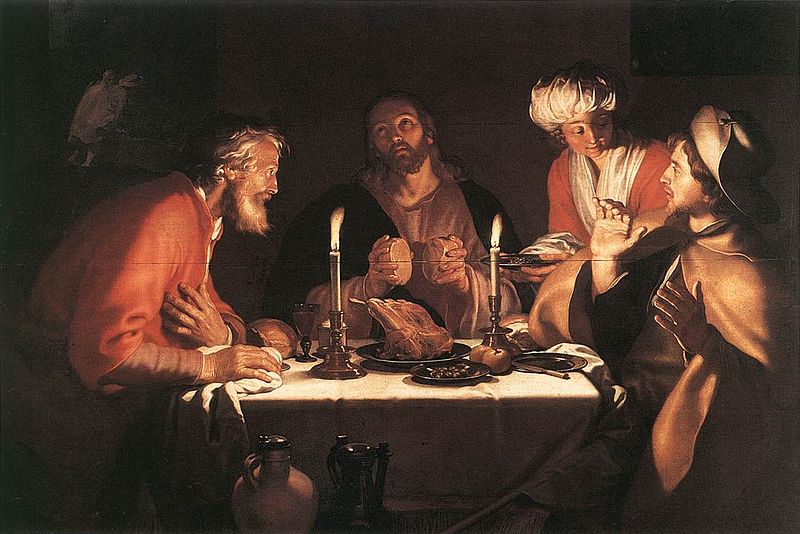
The Emmaus Disciples - Bloemaert - 1622


Today we hear (Lk 24:13-35) of the appearance of the risen Lord by some disciples on the road to Emmaus. We learn not only of this amazing encounter between the two disciples and the resurrected Christ, but also, at another level, how this encounter is a model of what the Church does for us.

The Church does for us what the risen Lord did for the disciples on the road. First He walked with them. Secondly He gave the ‘interpretation of Scripture’. Thirdly He celebrated the Eucharist (He took bread; He said a blessing; He broke it and gave it).

Through the Church our risen and ascended Lord walks with us. Our pilgrim journey as disciples is not a lonely one, but one in which we are accompanied by the Lord through His Church. The Church gives us the ‘interpretation of Scripture’, through the Church’s teaching authority (the magisterium). We do not need to wrestle alone with understanding the Scriptures but have the wisdom of all those who have been guided by the Holy Spirit to teach with authority. And, the Church celebrates and most truly is the Church when she celebrates the Eucharist.

We can come close to Jesus in the conversation of personal prayer and meditating on His words. We find Him present in our fraternal meetings, for when “two or three are gather in my name, there am I in your midst.” But our risen Lord makes Himself known to us in a wholly and qualitatively different way when we share the Bread of Life, His Body and His Blood.

So in this Eastertide let us rejoice that the Church is not primarily a human institution but that in the joyous encounter of the two disciples with the risen Lord on the road is a model of the Church. We can experience our Lord presence with us through the Church. We can be wholly confident in the magisterial teaching of the Church which is not the teaching of men but the teaching of Christ through His servants. And we are truly privileged to be able, by faith, to witness Christ Himself in the Eucharist. Let us not take any of these things for granted nor in any way work against them.

Fr Ian


Tuesday, 7 April 2015

Noli me tangere

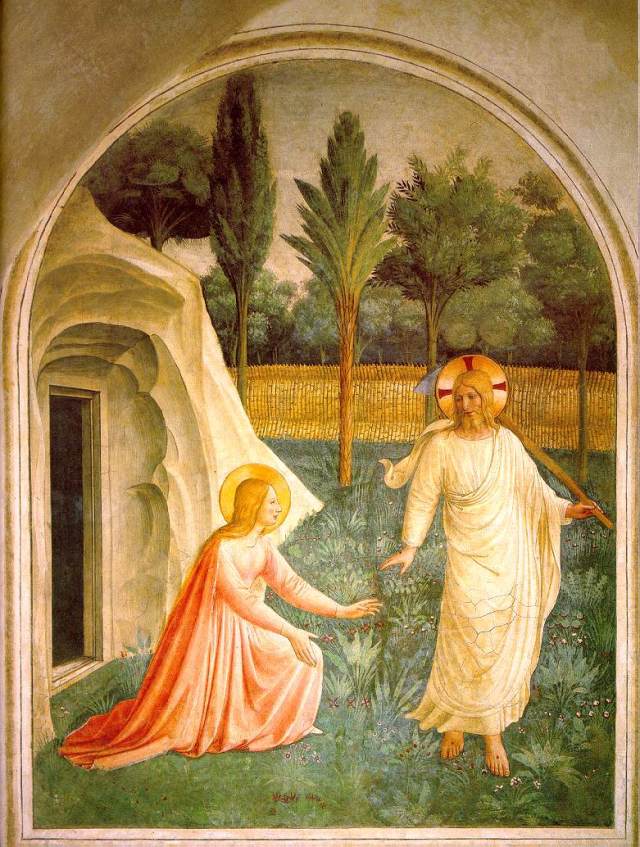
Noli me tangere - Do not touch me - Fra Angelico

“Do not cling to me,” are words that might seem quite harsh to those, like Mary Magdala, who loved Jesus much and also were filled with intense grief, but at his risen appearance were asked to hold back. Jesus had not, all of a sudden, become like an Englishman, who preferred not to be so demonstrative with regard to affections! So what is happening here?

Well of course the Resurrection has occurred! And this is not just a resuscitation of Jesus’ body (like Lazarus being raised from the dead) but a wholly new way of being human. So of course the way in which people relate to the risen Christ is now different. Yes it will be a human way of relating but it will necessarily be a spiritual way.

Eventually of course, after the Ascension, the risen Lord will not be seen until the end of time, but only seen through the sacramental signs of the Sacred Body and Precious Blood of the Eucharist. The disciples must relinquish the physical presence of Jesus with which they were so comfortable. From now on the disciples of Jesus must embrace Him in a secret and marvellous way through prayer and faith.

Mary Magdalene here may well represent the contemplative spirit of the Church and thus shows us how we are to embrace the whole of Christ.

Fr Ian

Monday, 6 April 2015

Joy from receiving absolution from Christ!


Both the joy and the import of the Resurrection are imbued in the words of St Peter as he preaches the first papal sermon in Jerusalem on Pentecost Sunday. Peter is of course filled with joy – who would not be? His Master and Saviour who had become a victim of the Jewish authorities and then a victim of the Roman authorities, even to a brutal death, was not overcome by death, but had risen.

For Peter personally, his sin against the Lord (denying his Master three times) had been forgiven. This is the joy we have too when we confess grave sin and experience the release from bondage in the absolution. It is a joyful resurrection experience – we were dead to sin, now we are alive to Christ! St Peter had been dead to the grave sin of denying Christ – now he was alive to the risen Christ!

And his joyful message for the Jews listening to him is that this Resurrection joy, through the forgiveness of their sins, can be there’s too. And of course, St Peter is addressing all of us in our sin; we too can receive the forgiveness of sins and experience the joy of the Resurrection life.

We who experience the Resurrection in this way, making use of the sacrament of penance, also have a duty to share it with others. Not necessarily like St Peter preaching in the streets of course, but nevertheless the joy of the Resurrection is not to be kept to ourselves.

Let us pray this Easter, that all of us may have the courage to proclaim, in one way or another,  the joy of the Resurrection with those who do not know it.

Fr Ian


Friday, 3 April 2015

The very crux of our faith - the movement of the biggest story of all


On this Good Friday we enter into the greatest of mysteries and the very crux of our faith. And it is about the triumphant movement of the biggest story of all – the story of the human race. 

In the origins of the human race we were created in goodness and love. Originally God made us in His own image and likeness. We lived in complete harmony and freedom. Made with freedom to love or not love, we were tested and alas failed the test. Satan tempted Eve, and then after Eve had fallen, she tempted Adam who also fell. Our ancient human ancestors fell from grace and innocence. The consequences of this fall were sin and death. We now did not freely delight in doing the good; instead we delighted in doing what was wrong. All the children and descendants of Adam and Eve suffer from this. And the fruit of this is all the evil we see in the world.

And we all inherit from our ancestors this propensity towards sin, which means in the end, death (real eternal death).  And so of course we need saving – we really, really need salvation, because, otherwise, all there is, is death for eternity (that’s what we call hell). So we need lifting up from this original sin and all our sins.  And the story of our salvation is a movement. It is a movement of descending and ascending, as St Paul puts so beautifully in his Philippian hymn (Phil 2:1-12).  God descends and becomes Man, that by our union with Him, we might ascend from our fallen state, and enjoy everlasting life (which is what we call heaven). 

That sounds great until we realise the price of the descending.  For the healing to happen, Christ must enter obediently into the heart of our problem. The heart of our problem is sin. The only perfect, good man must submit Himself to become the victim of injustice, hatred, untruth, disobedience and evil – the whole gamut of our fallen nature – that He might enter even into death itself.  By facing death in obedience, in truth, in righteousness, in total goodness and in perfect love, He is able to conquer death; to conquer evil; to conquer our fallen-ness; to conquer sin. This is how the victory occurs and it is wonderful but it is also awful at the same time.

Christ our God became the Priest and Sacrifice in the great Mass offered for us on the Cross, and His death, made present in every Mass thereafter, brings us the grace of this victory, and indeed the grace through all the Sacraments.

And so we rejoice this day in the Triumph of the Cross of our Saviour Jesus Christ.  We glory in His victory, yes bought at such an awful price, yet a wondrous and glorious and entirely complete triumph over sin, death and evil.  Our Enemy is defeated and we rejoice! It is truly a Good day.


Fr Ian

Thursday, 2 April 2015

Can it ever be a bad thing for a Catholic to receive the Eucharist?


“Whoever, therefore, eats the bread or drinks the cup of the Lord in an unworthy manner will be guilty of profaning the body and blood of the Lord.” 1 Cor 11:27

I remember talking to a group about how to prepare to receive the sacrament of the Eucharist, when someone said that surely it was never a bad thing to receive Our Lord in the Eucharist? Well St Paul disagrees! The offending Corinthians were guilty of overeating, drunkenness and discrimination against the poor. This was sufficient for them to be in a state of mortal sin and therefore the act of receiving the Body and Blood of Christ became an act of sacrilege and self-condemnation. So indeed there are circumstances when receiving the Lord in the Eucharist is a gravely immoral act.

St John Chrysostom says, in his commentary on Corinthians, that receiving the Lord unworthily is an act equivalent to the soldiers who crucified our Lord! They spilled His precious blood but did not drink it. His blood was made to pour forth but it was not for the Eucharist.

So how do we make sure we are not like the crucifiers of Jesus by receiving the Eucharist unworthily? The simple answer is that we need to take seriously our preparation for the Eucharist. And the bottom line is that if we are aware that we have committed grave sin then we should not receive the Eucharist until we have gone to confession. This is the teaching of the church.

St Paul reckoned that sinning in this sacrilegious way resulted in the Corinthians received divine judgement through their weakness, sickness and in some instances even death (1 Cor 11:30).

On this day when the Church celebrates the Mass of the Lord’s Supper, let us renew our practice of preparing ourselves to receive the Sacrament of the Eucharist. Let us examine ourselves and if our conscience convicts us of grave sin then let us refrain from receiving the Eucharist as an act of love towards our Lord, and let us hasten to the confessional to be reconciled and enter into the joy of the Lord.

Thanks be to God for His inestimable Gift.


Fr Ian

Reflections on Worship in Sacrifice