Last Saturday I went to the Westminster Diocese' day conference on the Family and Evangelisation. The principal speaker was Bishop Laflitte, who is Secretary to the Pontifical Council for the Family. Here is his address:
Wednesday, 13 March 2013
Tuesday, 12 March 2013
The Conclave has begun! Let us pray!

After a very solemn procession of Cardinal electors making their Oaths before God and on the Gospels, the doors of the Sistine Chapel have now been closed, and the time of prayer, discernment and decision has come to our fathers, the Cardinals of the Holy Catholic Church.
The Conclave has begun!
Let us pray, let us pray!
Catholic Herald Conclave page
Vatican Player
ROME REPORTS Youtube channel
Fr Ian Hellyer
Also an article well worth reading as it is so refreshing coming from the secular media: Julie Etchingham on ITV News at Ten .


Monday, 11 March 2013
Laetare Sunday - The Parable of the Two Sons

Mass
begins each week with a verse from Sacred Scripture. Mother Church
provides this for us, for our nourishment – although in recent decades we have commonly replaced it with a hymn or a ditty or something. I make a point when
I reflect on the readings for a homily, to begin with that verse.
Mother Church provides it for our nourishment, why should we neglect
it as if she would give us something we do not need? And this Sunday,
which we call Laetare Sunday, begins with “Laetare” - which
in English is, “Rejoice”.
Rejoice Jerusalem, and all who love her. Be joyful, all who were in
mourning; exult and be satisfied at her consoling breast.
It is a beautiful verse from Isaiah calling on us to rejoice with our
mother the Church, and to drink from her 'consoling breast', that is
to joyfully feed from that which she provides for us.
So we come to our mother the Church joyfully for food. And what food
does she provide for us today?
We are fed today with possibly what is the literary highpoint of
gospel writing; what we call generally the Parable of the Prodigal
Son. Unfortunately by calling it that name, we reveal a lot about
ourselves, because by prioritising one of the sons and side-lining
the other, we kind of say that really the parable is about the very
wicked son; and the other son, well, he's just a bit grumpy. In fact
the parable is the parable of the two sons. Both sons represent
immature ways of relating to God (to quote the Pope emeritus). It is
very important that we realise that both are wrong; both are sinful
but in very different ways; both are immature but in very different
ways.
The first son thinks he knows best. He doesn't want to hang around at
home wasting his time, so he commits a dreadful sin. He dishonours
his father; he demands his inheritance there and then: he effectively
says, I wish you were dead. This is an incredibly wicked thing to do
and would have seemed even more wicked at the time of Jesus. It would
have been the height of disrespect. And then, he travels to a foreign
land and his life then dissipates in dissolute living, until
eventually he has nothing. His fall is very great, but it has the
virtue of shaking him up and brings him at last to his senses. He now
realises his sin. He exemplifies the folly of rebellion. He is
immature through rebellion. He goes against his father to the very
extreme, and then falls, and then repents.
The
second son, who has remained at home and who has not disrespected his
father, who has been obedient, who has not lived a dissolute life,
who has worked steadily at home, is nevertheless equally immature in
his relationship with the father. His obedience is childish. He
thinks himself superior. He doesn't remain at home out of love, he
remains at home to be different to his brother, to be better than his
brother... And we can see that he has become filled with pride. When
his brother returns, he is not pleased at his brother's repentance
(unlike his father). The elder son is envious. He is sorrowful at
another person's good. He is immature. He is full of his own merits.
We call the parable the prodigal son because, partly at least, we
would rather not hear the second part about the elder son. In fact,
the elder son, despite the fact he has not sinned in obvious ways, he
has not sinned in lurid or scandalous ways, he has not publicly
humiliated himself, despite all this, he is in fact in a much more
difficult sinful position. He doesn't believe he needs forgiveness.
It is clear now that this parable is a warning to the religious, the
pious, to those who practice their religion meticulously, who are
careful not to cause scandal … but are doing it out of childish
obedience.
This parable is perhaps the highpoint of gospel literature not least
because it announces the truly astounding love of the Father. The
Father's love is greater than our wretchedness – the parable
portrays this very, very beautifully, with wonderful detail. The bit
which I love is when it says “while he was still far away, his
father saw him and was moved with pity...” An extremely moving and
touching detail. The father sees him coming and goes out to meet him.
You can sense in this the enormous compassion and eagerness to have
his son return home.
The Father's love though, is greater also than our own merits. For us
to enter into a mature relationship with God we need to appreciate
that we can do absolutely nothing to earn His love for us. Very
beautifully the father says to the elder son, “My son”, despite
the atrocious thing the elder son said, “all these years I have
slaved for you!” How could it be slavery? It was slavery in the
elder son's heart! But tenderly the father draws him out of his
anger, pride and envy, and says “all I have is yours”. To enter
into a mature relationship with the Father is not loss of freedom
(i.e. slavery) but in truth the greatest freedom of all.
As
we grow in maturity in relationship to our heavenly Father, we grow
to love obeying Him and His commands, it gives us delight, in fact it
gives us joy. Today is Laetare/rejoice
Sunday and we rejoice because we know our Father in Heaven. Our
Father has created us out of free, unselfish, love, and has created
us to be free – that is with a conscience that suffers when we get
lost, and is joyful when we return.
The
world has twisted our notion of freedom – that somehow we express
our 'freedom' when we rebel and do our own thing, and sees obedience
as a slavery, as the elder brother did. What the world has done is to
mix up freedom and license. Often the world is talking about licence
to sin, rather than freedom! Christ Himself reveals to us that
freedom is found through obedience to the Father who love us, and
whom we freely and lovingly obey, and do so in joy. And that is where
freedom is, in the joy. It is not in the knowledge that I can chose
to sin if I want to! Sin is always slavery, is always misery and
suffering in our conscience (however well it is hidden), and is far
from freedom. To be free is to be in a mature relationship with the
Father as His adopted sons and daughters, delighting in doing what He
asks of us, delighting in lively virtues growing in us, and not being
afraid. That is freedom and that is living in love and that is what
causes us to Laetare/Rejoice.
IH
Thursday, 7 March 2013
St Joseph, patron of the universal church, pray for us
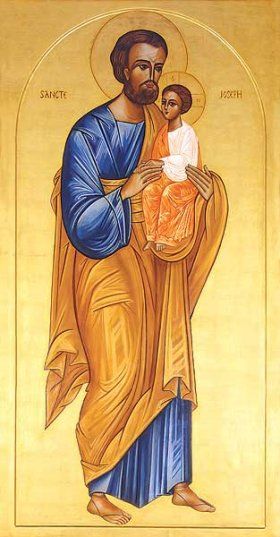
Cardinal Dolan invites us to keep a Novena to St Joseph from 11th to 19th (his Feast). Cardinal Dolan explains:
St. Joseph, a man of silence – and we need quiet reflection as the College of Cardinals and members of the Church;
St. Joseph, a man who dealt with emergencies – – think of his virgin wife’s “untimely,” embarrassing pregnancy; the birth of Jesus in exile, in a stable; the flight to Egypt to escape a murdering tyrant, the three-day loss of his boy – – with calmness, trust in God, and responsibility. What an example he is as we see so many “emergencies” in the Church and the world today!
St. Joseph, ever attentive to God’s will, placing Jesus and Mary at the heart of his life, reliable in his duties to care and protect his virgin wife and adopted son; a working-man who took pride in his profession as a carpenter.
No wonder we call him the Patron of the Church Universal. Wouldn’t it be great to have a new Pope by his feast-day?
It is an attractive idea; thank you Cardinal. more
Wednesday, 6 March 2013
The Atheist gets it!
This is quite an outstanding short clip where someone who claims to be Catholic (Piers Morgan) but thinks the Church should get with the times, is instructed by an outspoken Atheist on what it is to be Catholic.
Piers, who claims to be a Catholic, and is clearly frustrated by what he perceives is a real problem in the Catholic Church hasn't been bothered to ask someone who actually knows and understands the issues he is upset about. So along comes an Atheist who has thought about it, although doesn't agree, but nevertheless is in a much better position and instructs Piers on what it is to be Catholic. It is a priceless bit of television and reveals the stupidity out there masquerading as intelligent comment.
Piers, who claims to be a Catholic, and is clearly frustrated by what he perceives is a real problem in the Catholic Church hasn't been bothered to ask someone who actually knows and understands the issues he is upset about. So along comes an Atheist who has thought about it, although doesn't agree, but nevertheless is in a much better position and instructs Piers on what it is to be Catholic. It is a priceless bit of television and reveals the stupidity out there masquerading as intelligent comment.
Tuesday, 5 March 2013
Complacency dominates European Christianity
Third Sunday of Lent (Year C)

COMPLACENCY
Today's
readings ought to be approached with reverence and holy fear! We
ought to do that of course every
week, but particularly this week because they speak to us of a very
great spiritual problem that we suffer in our own time and in this
part of the world. The
problem that our readings today address is the problem of
complacency. I suggest to you that Christians in western Europe are
generally far too complacent – and what God's Word says to us in
the readings today, is that complacency will lead to downfall –
spiritual ruin.
For example, why is it that people in our society are far more
careful about not insulting Muslims than they are Christians? Why is
it that when religious freedom is trampled upon in our society the
most we can hope Christians will do is write a letter to their MP?
Why is it that when our society proposed to introduce the legal
destruction of unborn babies that we were not raging with righteous
anger and demonstrating on our streets? Why is it that when
Christians going about their normal work who refuse to promote
something that goes against their faith, are arrested, are fined, are
demoted, are sacked - we do very little or nothing about it? Why is
it that we have allowed our society on the back of equal rights
legislation to close down Catholic adoption agencies? Why is it that
when the prime minister proposes to re-define marriage in law most Catholics protested just by sending a post-card to
their MP? Why is
it that when in the last few days a police chaplain has been sacked
for publishing his support for traditional marriage on his personal
website, we have done very little?
What
will we do when teachers will be prevented from following their
conscience in the class-room, refusing to support gay marriage and
when they will almost certainly be sacked, what will we do? Anything? What
will we do if foster parents are prevented from telling their
children their beliefs in traditional Christianity? What will we do
as religious freedom after religious freedom is eroded in our
society? What will we do? The track record is not good! It is likely
we will do very little; at most contact our MP. And eventually our
nation will become a truly secular state and truly anti-religious.
And sadly brothers and sisters WE will have allowed
them to be eroded because of our complacency.
The erosion of religious freedom has been somewhat subtle of course.
The forces of this erosion don't portray themselves as being
anti-religious, but of being about stopping offensiveness,
of stopping us hurting feelings, of stopping us promoting prejudice,
of keeping our religion private and not imposing it on others.
One
of the reasons that we have allowed all this to happen is because
inside we have allowed our faith to be dulled. We don't like it when
our faith makes us feel uncomfortable, when it stirs us up, when it
challenges us. We don't like it. We like a faith that makes us feel
comfortable. We like a faith that settles our disturbing feelings.
What we want is just peace, an absence of conflict, within – that's
all!
Brothers
and sisters let me tell you today: that is NOT what God wants for
you, for me! God expects you and I to bear fruit in our lives, good
fruit (not moderately nice fruit). God is who He is, but He is also a God
who acts! He abhors complacency! He spits out of His mouth the
lukewarm! He does not want lukewarm followers!
In the parable of the fig tree in the vineyard, He says,
through the words of the gardener, about the fig tree that is not
producing fruit, “leave it one year and give me time to dig round
it and manure it: it may bear fruit next year; if not, then
you can cut it down.” Yes He
has mercy and gives it one more year but there will come a time when
He will say, “Cut it down.” St Paul referring to the lesson we
ought to learn from the Israelites who perished in the wilderness,
and never reached the Promised Land, says, “All this happened as a
warning... The man who thinks he is safe must be careful that he does
not fall!”
We
think God is a good chap, He won't really condemn us, He is a God of
love, and love means He will not give us a hard time. That
is not true! Love actually means He WILL give us a hard time. Love
means He is angry about our sins! He is angry because our sins
disfigure us, and distort the image of God within us. His anger is
actually good news for us because it means He really cares about us!
Does a mother or father show their love for their children if they
let their children continue in sinful behaviour? Of course not! They
are angry with their children's sinfulness! Love makes them angry!
They really care! God loves us more than we can imagine – but that
also means that God is angry with us, children of His, when we sin
against Him.
And
complacency is a great
sin of omission. We like to think it is a little sin – but it is
not. For evil to triumph it requires only that good men do nothing.
Not doing what we could have done. It is being lukewarm about our
faith – it is about avoiding anything that disturbs us, anything
that offends, anything that brings conflict. Being lukewarm is being
happy with a modicum of contentment and avoiding anything that
disturbs that. Being lukewarm about our faith means we will avoid
letting people know our beliefs, especially the beliefs that offend
others! Being lukewarm means we hide our faith under a bushel. We
only let it out on certain occasions, otherwise we carry on as if
everything is okay, that we are nice and inoffensive people!
His
Holiness Benedict XVI stepped down because he knows the successor of
Peter needs great energy to do what needs to be done, and although he
has done what he could
do even at a senior age, now his body is failing he knows he must
pass it on to someone who has
the needed energy. But unless we
become Catholics who are not complacent, but who have energy and
ardour for our faith, Catholicism and Christianity will continue to
decline in Europe no matter how energetic the new pope is. There is a battle going on, and our complacency
means what we want to do is avoid conflict, avoid showing that we
object to what is going on, avoid showing others what our faith
means. Complacency means we tend to drop our weapons: we tend to not
persevere in prayer when it becomes difficult, it means we tend not
to grow in knowledge of Scripture lest we hear God's Word, it means
we do not have a care to increase our knowledge of our faith because
then it will present us with too many challenges and require too much
time and energy of us. Complacency therefore means we surrender our
weapons! And of course without weapons we are bound to try to avoid
conflict!
We must approach the readings today with holy fear! We must listen to
St Paul saying that the Exodus is a warning to us all. God heard the
cry of His people in oppression in Egypt. He extended His arm against
the Egyptians with mighty wonders, and through Moses led His people
through the waters of the Red Sea to the Exodus. There He instructed
them on how to live their lives. But time and time again they
rebelled, they were disobedient, they were wayward, they did their
own thing as soon as Moses' back was turned! And St Paul tells us
that we should see this as a warning for us all, that many of them
perished before they reached the Promised Land! We also need to hear the
words of our Lord today, “unless you repent you will all perish as
they did.”
If there is only one tendency to sin, that we do something about this
Lent, brothers and sisters, let it be complacency that we really deal
with!
IH
2nd
March 2013
Subscribe to:
Posts (Atom)
-
A group of Anglican nuns from the Community of St Mary the Virgin (CSMV) in Wantage, Oxfordshire, are to be received into the full co...
-
 1 . St Mary Magdalene On Friday 22nd July the parish of Our Lady & St. Mary Magdalene, Tavistock, celebrated it's Patronal Festi...
 -
 On the solemn feast of Our Lord Jesus Chist, universal King, the Buckfast Ordinariate Group celebrated Sunday mass in a different location...
